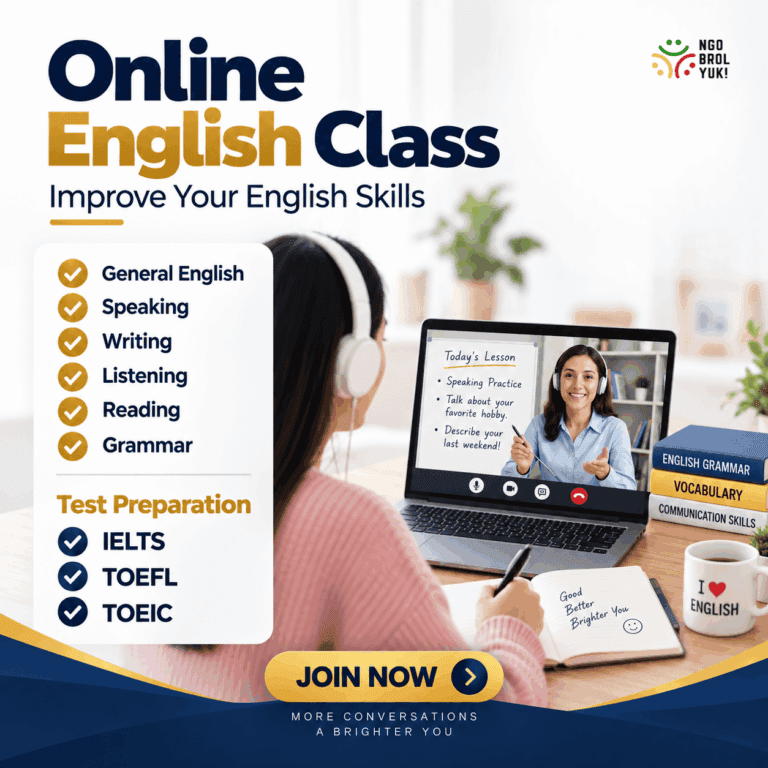
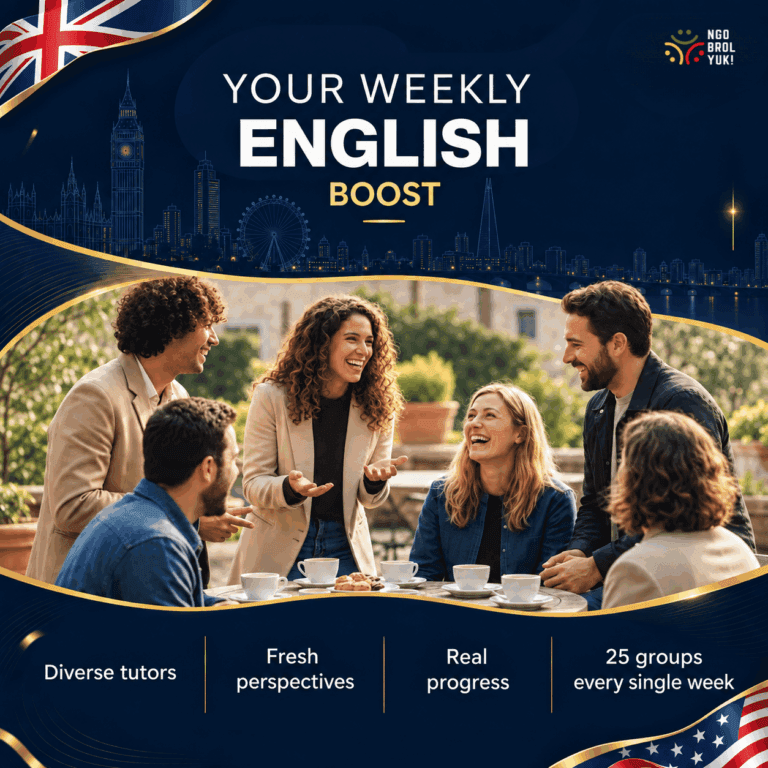
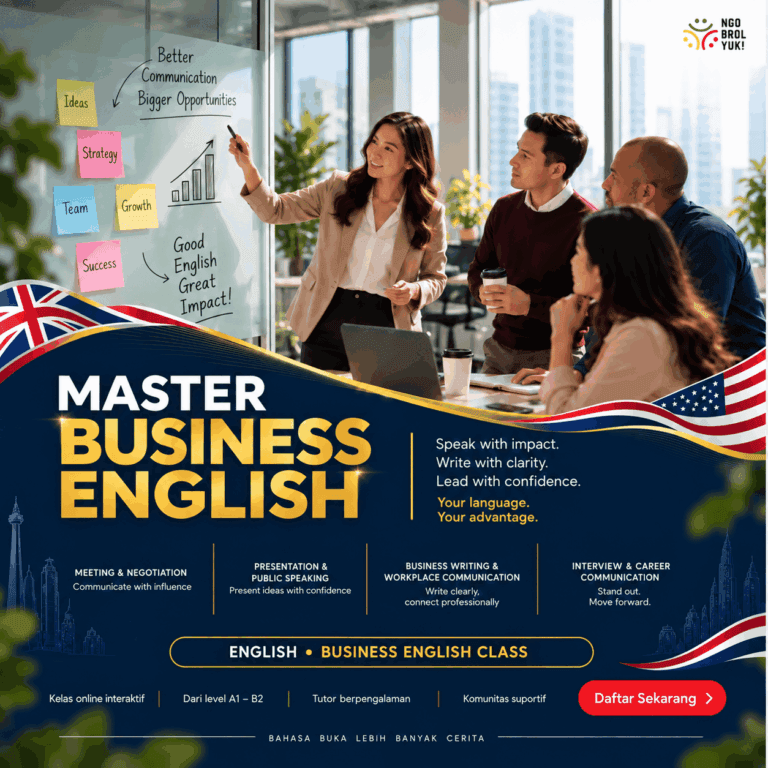
Learning a language shouldn’t be just about sitting, memorizing, and hoping to become fluent one day. At Ngobrol Yuk, we believe that language should be brought to life through real conversations — just like when we first learned to speak. Here, you won’t just learn vocabulary and grammar, but will truly be trained to think, respond, and communicate naturally. Each class is designed to make you feel comfortable and confident, and slowly, without you realizing it, your language skills will grow rapidly.
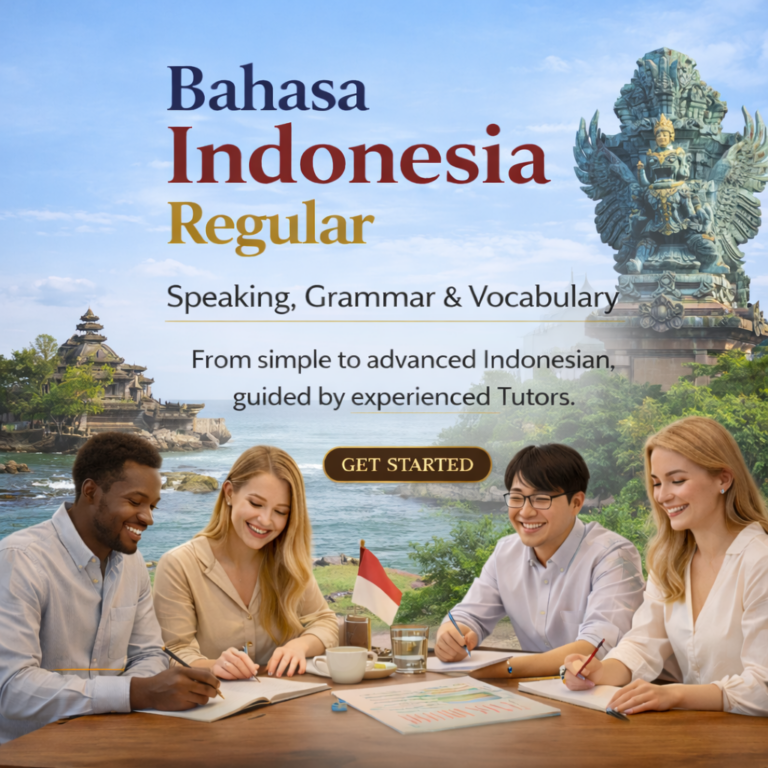
Regular classes at Ngobrol Yuk offer a structured learning experience with between 6 to 10 participants, creating a comfortable and interactive environment. The class schedule is fixed, taking place twice a week with a duration of 90 minutes per session. This format is designed to help participants learn consistently, deepen their understanding of the material, and actively practice with classmates in a supportive atmosphere.
Semi-Private Class (Private Group) is the ideal option for 2–4 people who know each other — such as friends, family, or colleagues — to learn a language together in a focused yet relaxed setting. With a small number of participants, each student still receives personal attention from the tutor while enjoying the interactive dynamics of group learning. This model offers a learning experience close to that of a private class but at a more affordable price, making it perfect for those who want to study seriously while sharing the experience with their closest ones.
Private classes at Ngobrol Yuk offer a fully personalized learning experience tailored to each participant’s individual needs and goals. In this class, the schedule is more flexible and can be arranged based on an agreement between the student and the tutor. Through a one-on-one system, students receive full attention, making the learning process more effective and focused on specific topics or skills they wish to develop. The duration of each session can also be adjusted, providing comfort and optimal results for participants. This private class is perfect for those who want a personalized and flexible learning experience.
Beginner: Your First Step
Level A1 is the starting point of your journey in learning Spanish.
At this stage, you will build a strong foundation to get used to understanding and using the language in real everyday situations.
How to greet, introduce yourself, and ask how someone is.
Personal pronouns (pronombres personales): yo, tú, él/ella, nosotros...
Articles and noun genders (el, la, los, las).
Basic adjectives to describe people and things.
Common vocabulary related to family, time, food, and daily routines.
Goals:
Be able to communicate in simple everyday situations.
Use basic sentence structures correctly.
Demonstrate a basic understanding of essential vocabulary and grammar.
From Basics to Real Communication
This level expands your communication skills, teaching you how to connect ideas and form more expressive sentences.
You will practice speaking naturally about past experiences, future plans, and everyday situations.
Regular and irregular verbs in presente de indicativo (tener, hacer, poder, decir, venir, querer, ir).
The use of verbs such as gustar, encantar, preferir, as well as reflexive verbs (levantarse, ducharse) and the structure estar + gerundio to express ongoing actions.
The use of comparatives and superlatives such as más que, menos que, el más inteligente.
An introduction to past tenses such as pretérito perfecto simple, pretérito perfecto compuesto, and imperfecto, along with reinforcement of the presente de indicativo.
Goals:
Be able to tell stories and share simple experiences in Spanish.
Communicate with native speakers in everyday contexts without fear.
Use basic grammar and past tenses more fluently and accurately.
Independent Communication in Spanish
“Start thinking and speaking like a native speaker.”
At this level, you don’t just understand sentences—you begin to express your ideas and feelings clearly. You’ll practice speaking more fluently, understanding longer conversations, and writing more structured texts.
Past tenses (pretérito perfecto, indefinido, imperfecto, pluscuamperfecto).
The use of futuro and condicional simple to talk about the future and possibilities.
An introduction to subjuntivo básico to express wishes, doubts, and suggestions.
Vocabulary related to work, social relationships, travel, and everyday life.
Goals:
Understand longer conversations and more complex texts.
Be able to tell stories, describe events, and express opinions clearly and coherently.
Communicate fluently in everyday and familiar situations.
Upper Intermediate Fluent and Spontaneous Communication
Express your ideas and opinions with confidence and precision.
This level will help you achieve greater fluency and accuracy in Spanish. You’ll be able to engage in discussions, write essays, and understand media content with deeper comprehension.
Mastery of the modo subjuntivo (presente dan imperfecto) across various contexts.
Correct use of pasiva refleja and voz pasiva.
Use of complex oraciones condicionales, relativas, and concesivas.
Goals:
Actively participate in discussions and debates, expressing opinions clearly and coherently.
Understand complex texts and audio materials, including academic or professional topics.
Write and speak with grammatical accuracy and a natural linguistic style.
Develop cultural and linguistic awareness for smooth cross-cultural communication.
Every journey starts with a single word.
You’ll learn how to introduce yourself, talk about your family, daily routines, and hobbies, and understand simple questions in real-life situations.
What You’ll Learn
Goal:
By the end of this level, you’ll be able to hold short, simple conversations and understand familiar everyday expressions.
Now that you’ve found your voice, it’s time to use it more often and with confidence.
This level helps you speak and understand English in everyday contexts, from travel and shopping to describing your experiences.
What You’ll Learn
Goal:
You’ll be able to describe events in the past, express opinions, and interact with others in short social conversations.
At this stage, English becomes part of your world.
You’ll learn to speak more independently, express opinions, and handle unexpected situations in travel, study, or work.
What You’ll Learn
Goal:
By the end of B1, you’ll speak with more fluency and understand most everyday conversations, films, and discussions at a moderate speed.
Now you’re ready to sound natural and confident in almost any situation.
This level strengthens your accuracy, fluency, and vocabulary, helping you speak effectively in both casual and professional settings.
What You’ll Learn
Goal:
You’ll be able to communicate fluently, express detailed opinions, and adapt your language naturally in formal and informal situations.
Objective: Communicate in simple everyday situations.
Main Topics:
⏱ Estimated Duration: 40–60 hours (approx. 1–1.5 months intensive)
Objective: Understand frequently used sentences and expressions, and start telling simple stories.
Main Topics:
Estimated Duration: 60–80 hours
Objective: Interact with native speakers in general social and work contexts.
Main Topics:
Estimated Duration: 80–100 hours
Objective: Understand the main ideas of complex texts and actively participate in discussions.
Main Topics:
Estimated Duration: 100–120 hours
Objective: Use Indonesian effectively, flexibly, and naturally in academic, professional, and cultural contexts.
Main Topics:
Estimated Duration: 150–200 hours (or more depending on learner’s goals)
Additional Notes:
What You Will Learn:
Ideal Duration: 10–20 sessions (depending on intensity & learning speed)
Best for: Total beginners who want to start from zero.
What You Will Learn:
Ideal Duration: 15–25 sessions
Prere Best for quisite: Completed Chuji Shang / equivalent to HSK 1.
What You Will Learn:
Ideal Duration: 20–30 sessions
Best for: Completed Chuji Xia / equivalent to HSK 2
What You Will Learn:
Ideal Duration: 30–45 sessions
Best for: Completed Zongji Shang / equivalent to HSK 3.
What You Will Learn:
Ideal Duration: 30–45 sessions
Best for: Completed Zongji Xia / equivalent to HSK 4.
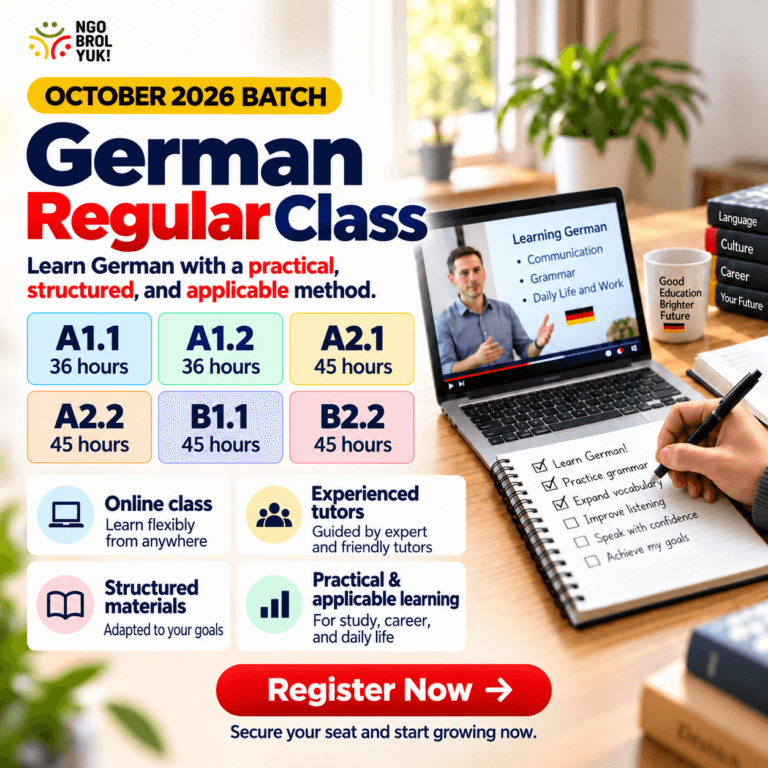
Start from zero and build confidence in using German in everyday life.
You will learn how to introduce yourself, ask simple questions, and handle various daily situations.
Main Topics:
The German alphabet and basic pronunciation
Greetings & farewells, introducing yourself and others
Numbers, time, days, dates, months
Polite expressions (excuse me, thank you, sorry, please)
Basic sentence structure (S + V + O/C)
Sentence types: statements, W-questions, and yes/no questions
Basic vocabulary: jobs, hobbies, food & drinks, transportation, weather, daily activities
Simple conversations: shopping, ordering food, asking for directions
Basic Grammar:
Definite & indefinite articles (der/die/das, ein/eine)
Regular & irregular verbs
The verbs haben & sein
Accusative & Dative cases
Modal verbs (können, müssen, wollen, dürfen, sollen)
Präteritum of haben & sein
Prepositions of time & place (am, um, von…bis, in, mit, für)
Imperative forms (du, ihr, Sie)
Separable verbs (Trennbare Verben)
Personal & possessive pronouns (ich, du, er, sie, mein, dein, etc.)
Go beyond the basics and start expressing yourself more naturally.
Learn how to talk about experiences, express feelings and opinions, and understand various everyday content such as blogs or short stories.
Main Topics:
Talking about school experiences & the past
Expressing opinions and viewpoints
Comparing advantages & disadvantages
Expressing feelings & moods
Making appointments and giving reasons
Comparing objects/situations and expressing opinions
Reading/constructing complex sentences with clauses (Nebensätze)
Writing simple texts such as blogs, comments, or short letters
Listening to and understanding light information from the web or radio
Reading and understanding descriptions of cities, jobs, or movies
Giving advice, answering questions, and making clarifications
Grammar:
Genitive case (noun + s)
Subordinate clauses with weil, wenn, dass
Modal verbs in Präteritum
Comparative & superlative forms
Konjunktiv II (for possibilities & giving advice)
Indirect questions (with ob)
Two-way prepositions & prepositions of direction/place (Wechselpräpositionen)
Relative clauses in nominative & accusative cases (Relativsätze)
Indefinite pronouns
Reflexive verbs
Adjectives & structures after articles
It’s time to go deeper. Express your opinions, take part in various discussions, and use German confidently for studying, working, or traveling.
You will develop greater accuracy and fluency while learning to handle unexpected situations and understand more complex ideas.
Topics:
Expressing likes & dislikes
Planning trips & writing travel stories
Comparing, giving reasons & counterarguments
Writing comments, advertisements, reports & articles
Debating, expressing opinions & defending viewpoints
Giving advice & expressing possibilities using Konjunktiv II
Building and understanding complex sentences (Nebensätze)
Using the passive voice in different tenses
Connecting information through adaptive sentences (conjunctions, relatives)
Discussing social & cultural changes
Talking about environmental issues & practical solutions
Describing art & cultural expressions in detail
Managing dialogues, clarifications & improvisations
Grammar:
Infinitives with zu; da / obwohl / damit / um … zu
Genitive case, prepositions with Genitive (wegen, trotz)
Präteritum, Plusquamperfekt
Konjunktiv II & unreal clauses (irrealis)
Konjunktiv in conditional sentences
Pronouns & pronominal adverbs
Verbs with prepositions & reflexive verbs
Time & partitive prepositions with Dative & Genitive
Temporal subordinate clauses (bevor, nachdem, seit/seitdem, während)
Relative clauses (with was, wo)
Passive sentence structures (Present, Präteritum & Perfekt), including passive with modal verbs
Partizip I & Partizip II used as adjectives
Achieve fluency in German with confidence and natural expression.
At this level, you will learn to express complex ideas clearly, participate in advanced discussions, and write in a more mature and professional style.
You will strengthen grammatical accuracy and expand your vocabulary while communicating naturally in academic, social, and professional contexts.
Main Topics:
Expressing abstract ideas and opinions with nuance
Writing structured essays, formal emails, and detailed reports
Debating and presenting arguments clearly and confidently
Summarizing and interpreting information from various sources
Discussing current issues, culture, and global topics
Giving presentations and participating in formal discussions
Understanding authentic materials such as news articles, podcasts, and short literary texts
Expanding vocabulary for study, work, and daily communication
Developing advanced listening and reading comprehension skills
Perfecting fluency through interactive conversation practice and real-life situations
Grammar:
Advanced Konjunktiv II and conditional clauses
Passive sentences in all tenses, including with modal verbs
Partizip I and Partizip II as adjectives or descriptive modifiers
Subordinate clauses with obwohl, trotzdem, damit, sodass, falls
Nominalization and restructuring of complex sentences
Relative clauses with advanced prepositions and conjunctions
Review and reinforcement of all main tenses (Präsens, Präteritum, Perfekt, Plusquamperfekt)
Prepositions and idiomatic expressions
Indirect speech and advanced sentence constructions